Germany’s Accessibility Strengthening Act (Barrierefreiheitsstärkungsgesetz, BFSG for short) has been a topic of discussion in agency and shop-operator circles for a while, but for many of our clients it hasn’t really landed yet. And yet the deadline has long passed: since 28 June 2025, the actual obligations of the law have been in force, and for a large share of websites and online shops in Germany that simply means: accessible, or not legally compliant.
We break down what’s behind the BFSG, who it affects and how, as a website or shop operator, you can close any remaining gaps as quickly as possible.
What to expect in this article
- What is the BFSG anyway?
- Who is affected by the BFSG?
- Exemption for micro-enterprises
- Which standard must my website meet?
- What happens in case of non-compliance?
- The biggest problem areas in online shops
- Your roadmap to compliance
What is the BFSG anyway?
The Accessibility Strengthening Act transposes an EU directive, the European Accessibility Act, into German law. It was passed back in 2021, so formally it has been the law of the land ever since, just with a long transition period. That period ended on 28 June 2025. Since then, the affected products and services have had to actually meet the accessibility requirements set out in the law, not just plan for them on paper.
At its core, the BFSG pursues the same goal as the longer-established BITV (the German regulation on accessible IT) for government websites, only for the private sector. If you thought accessibility was purely a public administration topic, the summer of 2025 was the moment to reassess.
Who is affected by the BFSG?
The law targets products and services aimed at consumers (B2B offerings are, as a rule, not covered). Among the areas covered are:
- Computers and operating systems
- Self-service terminals such as ATMs, ticket machines or check-in kiosks
- Smartphones and comparable devices with an interactive user interface
- E-book readers
- Consumer banking services
- Passenger transport services, e.g. passenger information and ticketing in air, rail, bus and ship travel
- Telecommunications services
- E-commerce services, i.e. classic online shops
For most of our clients, that last item is the decisive one: anyone running a web shop through which consumers in Germany or the EU can buy falls under the BFSG. That applies regardless of whether the shop runs on WooCommerce, Shopware or another system: the law is formulated technology-neutrally and looks at the outcome, not the platform used.
Exemption for micro-enterprises
Not every company falls under the obligations. For micro-enterprises the law provides an exemption: anyone employing fewer than ten people with an annual turnover or balance sheet total of at most two million euros is exempt from the obligations, but only as far as services are concerned.
That’s an important distinction we find ourselves explaining again and again in consultations: anyone who places products on the market themselves (say, their own hardware or their own e-book readers) cannot invoke this exemption. A pure online shop selling third-party products, on the other hand, counts as a service; here the micro-enterprise exemption applies, provided the thresholds are met.
Our assessment: even if you’re formally exempt, don’t ignore the topic entirely. Many of the measures the BFSG demands simultaneously improve usability and SEO, from clean contrast to sensible alt texts. In the end, accessibility isn’t a bureaucratic exercise; it makes a website easier to use for all visitors.
Which standard must my website meet?
The law itself remains technically abstract in many places. It becomes concrete via the WCAG (Web Content Accessibility Guidelines), currently version 2.1, conformance level AA. That’s the same standard the BITV for government websites has followed for years, and it will likely also serve as the reference point for the presumption of conformity under the BFSG.
WCAG 2.1 AA covers, among other things:
- Minimum contrast between text and background (4.5:1 for normal text, 3:1 for large type)
- Full operability by keyboard, without a mouse
- Understandable, programmatically determinable forms with labels and error messages
- Meaningful alt texts for images
- A page structure that can be navigated sensibly with a screen reader (heading hierarchy, landmarks, skip links)
If you’ve ever tried operating your own website exclusively with the keyboard, or perceiving it with your eyes closed via a screen reader, you quickly get a feeling for how many of these points remain open in practice. On the vast majority of websites we’ve audited so far, it was more than the operators had assumed.
What happens in case of non-compliance?
Enforcement lies with the market surveillance authorities of the German federal states. They can intervene in case of violations, demand remediation and, in serious cases, impose fines. In addition, recognised consumer protection associations gain the ability under the law to take action against providers who don’t comply.
How strictly the authorities crack down in individual cases is still taking shape; from experience with comparable regulations such as the GDPR, we wouldn’t bet on authorities and associations watching idly for long. What has changed is the starting position: anyone who hasn’t adapted their website yet is no longer preparing — they are in default. Every month the findings are fixed earlier shortens the window in which the website is exposed.
The biggest problem areas in online shops
In the audits we’ve carried out for clients over recent months, a few problems keep coming up. The good news: none of them requires a complete website relaunch if you tackle them systematically.
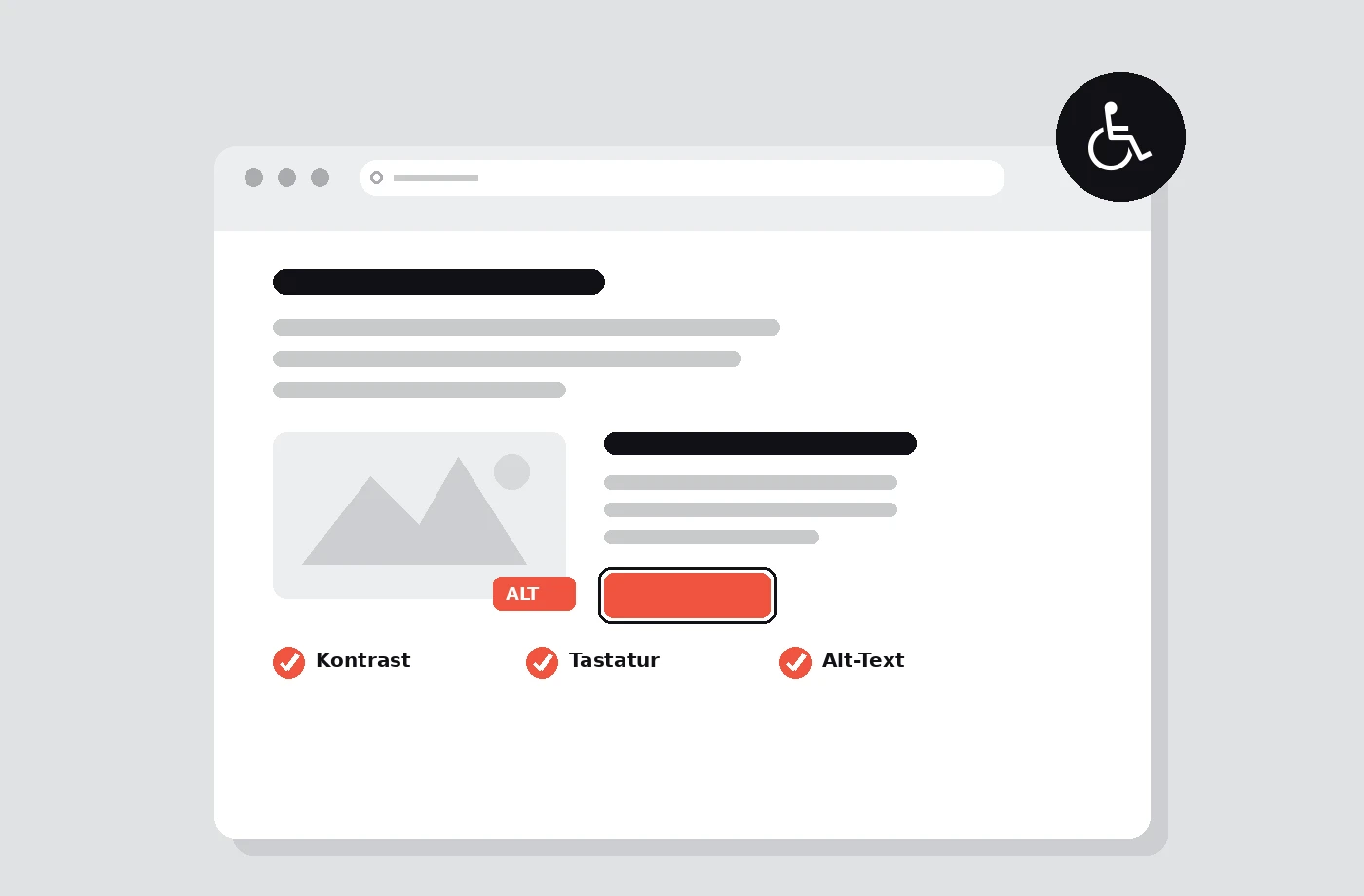
The most frequent findings in our audits:
- Product images without alt text, or with meaningless alt texts such as “IMG_2384”
- Insufficient contrast between body text and background, usually light grey text on a white ground
- Cart and checkout processes that cannot be completed without a mouse
- Form fields without linked labels, so screen readers announce only “input field” instead of “email address”
- Form error messages marked purely by colour (red), without additional text or an icon
- Sliders and product carousels that cannot be operated or paused by keyboard
Most of these points can be fixed with manageable effort if approached systematically. A cart that can’t be operated by keyboard is usually a CSS or JavaScript problem in the theme, not a fundamental architectural one.
Your roadmap to compliance
From our experience with similar transitions, a structured approach beats hectic activism:
In summary:
- Run a technical audit now, manually and with automated tools, since scanners alone only cover part of the WCAG criteria.
- Prioritise the findings: contrast and alt texts are usually done quickly; form and keyboard operability need a bit more lead time.
- Schedule the implementation promptly rather than pushing it further out; until then, the website remains exposed.
- After implementation, test once more with keyboard and screen reader, not just by eye.
- Establish accessibility as an ongoing topic, not a one-off project. New content and products should meet the same standards.
We are currently guiding several clients through exactly this process, from the first audit to the technical implementation. How audits and remediation work at aceArt is covered on our accessible websites service page; the CMS-specific details have their own pages on WordPress and TYPO3. If you don’t yet know where your website or shop currently stands, a first conversation about it is the simplest next step.
This article provides an overview of the key points of the BFSG but does not replace individual legal advice. Whether and to what extent the law applies to your company should, in case of doubt, be clarified with a qualified professional. All information without guarantee.